Occupancy analytics and space utilisation
See how your buildings are really used
- Real-time occupancy counts for every room, floor, and building
- Space utilisation analytics that compare what was booked with what happened
- Privacy first: no cameras, no personal data, no Wi-Fi dependency

The problem with booking data
Timetables and room bookings tell you what was scheduled. They assume every session runs and every seat is filled. A once-a-year utilisation survey captures a single week. Neither shows what your buildings actually do, hour by hour, so estates decisions get made on assumptions instead of evidence.
Teaching room utilisation
Measure how many teaching rooms are in active use in each operating hour, and how full they are when occupied. Find the rooms that are systematically over-specified and right-size them against real demand.
Library and study spaces
Show students where there is space to work, and show estates teams the real pattern of demand across the day and the term. Identify peak hours, underused floors, and the split between quiet and collaborative study.
Estate right-sizing and capital planning
Base consolidation, conversion, and new-build decisions on measured occupancy rather than booking assumptions. Make the case for or against investment with evidence the finance team can rely on.
Energy and sustainability
Align heating, cooling, and cleaning with actual occupancy instead of fixed schedules. Cut the cost of conditioning rooms that booking data says are busy but nobody is using.
How occupancy counting works
Small Bluetooth beacons are fixed to walls or ceilings with self-adhesive. They form a wireless mesh that reports to a single gateway per building, one power socket and one network connection. No cabling runs to each beacon, and no dependency on campus Wi-Fi.
The beacons count the Bluetooth signals that phones and other devices broadcast as people move through a space. The system counts unique devices per zone without identifying anyone, then applies machine learning to convert device counts into accurate people counts, accounting for device penetration, time of day, and building type. The result is reliable, real-time occupancy data, captured without cameras and without collecting any personal data.
Because the count is continuous, you can overlay your timetable or room-booking data to compare planned use with actual use. That comparison shows where booked sessions had no attendance, where rooms are busy with no booking at all, and which spaces are consistently larger than the groups using them. Timetable data is imported from your existing scheduling system.
What the data shows
In a recent study of 186 rooms across a multi-campus UK university, only 39.8% of rooms were in active use in a typical operating hour. Six in ten rooms sat empty. Where rooms were occupied, headcount averaged 35.8% of capacity, so the rooms in use were also, on average, two-thirds empty.
The same data found that 17.5% of timetabled events recorded no attendance: one booked session in six produced no measurable occupancy, holding a room unavailable to others for an event that did not happen. It also surfaced more than 25,000 off-timetable room-hours, rooms in active use with no corresponding booking, activity the institution previously could not see or plan for.
This data came from infrastructure already installed in the buildings. For estates teams, that is the starting point for decisions about consolidation, right-sizing, cleaning, and energy, and a space utilisation guide for universities sets out how to read each metric.
Why choose Crowd Connected
One platform, one install
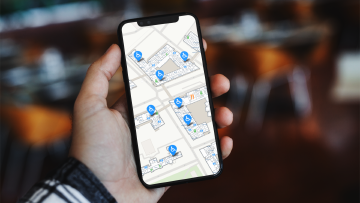
Occupancy counting, space utilisation analytics, blue-dot wayfinding, and asset tracking all run on the same Bluetooth mesh and the same platform. Most occupancy vendors do one of these. You would need a separate supplier for each.
Privacy first
Counting captures aggregate numbers, not people. No cameras, no facial recognition, and no Wi-Fi MAC addresses. There is no personal data to govern, which makes the data straightforward to share and simple under UK GDPR.
Whole buildings, low cost
A single gateway covers an entire building and battery-powered beacons install in hours with no cabling. Compared with sensor grids that need one device per few square metres, the cost per square metre at campus scale is far lower.
Works with existing infrastructure
Where a Crowd Connected mesh is already deployed for wayfinding or analytics, occupancy data can often be produced from it with no new hardware at all.

Frequently asked questions
What is occupancy analytics?
What is space utilisation and how is it measured?
How does occupancy counting work without cameras?
Can you compare occupancy against our timetable?
What is a good space utilisation rate for a university?
Is occupancy counting compliant with UK GDPR?
Get updates and insights from Crowd Connected
Thank You
Thank you for submitting your details. You're signed up to our newsletter!
Sorry
There was a problem submitting this form. Please check your entries, ensure you're online, and try again.