WiFi RTLS vs Bluetooth RTLS: which delivers better accuracy at lower cost?
Modern Real-Time Location Systems (RTLS) technologies are transforming indoor positioning and asset tracking. But not all RTLS solutions are created equal. Many organisations find that popular options based on existing WiFi access points or Bluetooth Low Energy (BLE) gateways fall short - in performance, scalability, or cost.
In this article, we explain why Crowd Connected’s RTLS hardware delivers superior results - with better accuracy and lower cost - for both indoor positioning and asset tracking.
How RTLS Works: Indoor Positioning vs. Asset Tracking
Accurate RTLS depends on fixed infrastructure installed in known locations:
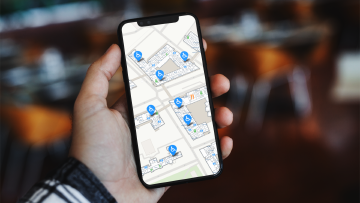
- For indoor positioning (wayfinding on smartphones), fixed devices transmit signals. Phones receive these signals and calculate their position.
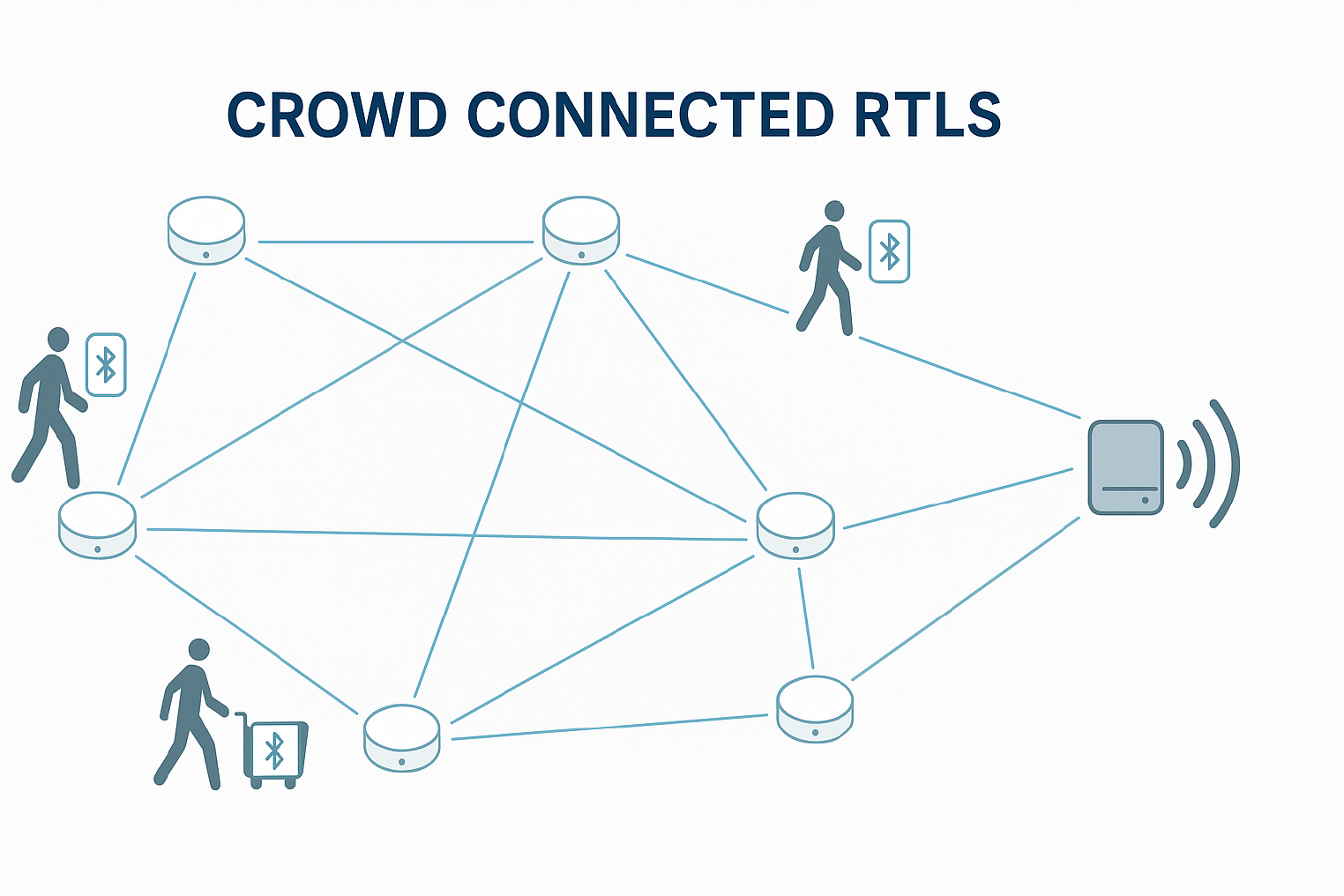
- For asset tracking, mobile BLE tags transmit signals. Fixed devices receive these signals to determine tag location.
In both cases, accurate real-time location tracking requires well-placed infrastructure, typically at sufficient density to cover the building.
Why Bluetooth is the Best Technology for RTLS
Bluetooth Low Energy (BLE) is the ideal radio technology for modern RTLS:
- All smartphones can receive BLE signals - ideal for indoor positioning.
- BLE asset tags are inexpensive, battery-powered, and widely available.
- BLE performs well in typical indoor environments, offering a cost-effective and scalable solution.
Limitations of Existing RTLS Approaches
1. Standard Bluetooth Beacons
- BLE beacons can provide indoor positioning.
- But they are transmit-only - unable to receive signals from asset tags - so they can’t provide asset tracking.
2. WiFi Access Points with BLE Radios (e.g. Cisco Spaces, Aruba, Ruckus)
Many modern WiFi access points now include BLE radios, and some RTLS solutions attempt to use these APs as BLE receivers for asset tracking.
However, these access points are usually installed to optimise WiFi coverage, not RTLS accuracy:
- They are rarely placed in the right locations or at sufficient density for accurate real-time location tracking.
- Retrofitting a WiFi network to meet RTLS needs is expensive and often impractical.
To be clear: this is not about using WiFi signals themselves (RSSI-based WiFi positioning), but about using WiFi APs as BLE sensors - a suboptimal solution.
3. BLE RSSI-based Gateways (e.g. Kontakt.io, Blyott, BlueRange, Estimote, Minew, Cassia Networks)
Other BLE-based RTLS solutions - such as those from Kontakt.io, Blyott, BlueRange, Estimote, Minew, Cassia Networks, rely on powered BLE gateways to act as BLE receivers.
These powered devices are:
- Relatively expensive per unit
- Require permanent power and wired or WiFi network backhaul
- Limited in placement by where power and cabling are available
- Costly to deploy at optimal density for accurate RTLS
The Better RTLS Solution: Crowd Connected
Crowd Connected offers a new approach to RTLS:
- Our small, battery-powered, wire-free devices are as simple to deploy as BLE beacons.
- They provide indoor positioning for smartphones.
- They also act as BLE receivers, picking up signals from asset tags.
- Data is relayed device-to-device back to a single network-connected gateway - meaning only one powered connection per large area is required.
RTLS Competitor Comparison: Why Crowd Connected Wins
| Feature / Solution | WiFi AP BLE Radios (Cisco Spaces, Aruba) | BLE Gateways (Kontakt.io, Blyott, etc.) | Crowd Connected |
|---|---|---|---|
| BLE RSSI-based Indoor Positioning | ✅ Possible, but suboptimal | ✅ Good | ✅ Excellent |
| BLE RSSI-based Asset Tracking | ✅ Possible, but suboptimal | ✅ Good | ✅ Excellent |
| Infrastructure Cost per Unit | ⚠️ High (enterprise WiFi AP) | ⚠️ Medium-High (dedicated gateway) | ✅ Low (beacon-like device) |
| Requires Permanent Power | ✅ Yes | ✅ Yes | 🚫 No (battery-powered) |
| Requires Network Backhaul at Each Device | ✅ Yes | ✅ Often yes | 🚫 No (mesh to single gateway) |
| Placement Flexibility (for RTLS performance) | ⚠️ Limited (WiFi design-driven) | ⚠️ Limited (power-driven) | ✅ Flexible (placed for RTLS) |
| Deployment Speed | ⚠️ Slow (reconfig/re-cable APs) | ⚠️ Moderate (power & network required) | ✅ Very fast (battery install) |
| Total Cost of Ownership (TCO) | ⚠️ High | ⚠️ High | ✅ Low |
Addressing IT Security and Wireless Coexistence Concerns
Some vendors (such as Cisco Spaces) suggest that non-WiFi-AP-based RTLS solutions can create a “shadow network” that may cause security or interference risks.
Crowd Connected’s architecture was specifically designed to avoid these problems:
✅ Battery-powered devices do not connect to the corporate network
✅ Only a single gateway connects to the network, fully under IT control
✅ Wirepas mesh networking uses the 2.4 GHz band but implements intelligent channel selection to coexist cleanly with WiFi - proven in large deployments (see Wirepas coexistence documentation)
✅ No impact on WiFi AP configuration or performance
In short: Crowd Connected does not introduce an uncontrolled shadow network, does not impact WiFi, and is IT-friendly by design.
👉 For more details, see our dedicated post: RTLS Security, Shadow Networks, and WiFi Coexistence.
Why Crowd Connected RTLS is Superior
✅ No need for expensive BLE-WiFi gateways
✅ No dependence on suboptimal WiFi access point placement
✅ No dense cabling or power requirements
✅ Rapid, low-cost deployment
✅ Optimised for both indoor positioning and asset tracking
✅ Scalable and flexible - easily adjust or expand coverage as needed
Summary: Beyond WiFi APs and BLE Gateway Limitations
Solutions based on WiFi APs with BLE radios (such as Cisco Spaces, Aruba, Ruckus) cannot deliver consistent, accurate RTLS.
Dedicated BLE RSSI-based gateway solutions (such as Blyott, Kontakt.io, BlueRange, Estimote, Minew, Cassia Networks) are expensive and power-hungry.
Crowd Connected’s RTLS hardware provides a better alternative:
- More flexible
- More cost-effective
- Easier to deploy at scale
- Optimised for accuracy in both indoor positioning and asset tracking.
Further reading
For a broader comparison of all indoor positioning technologies - including BLE, UWB, Wi-Fi RTT, fingerprinting, and more - read our indoor positioning systems guide for 2026. To learn more about how our patented self-calibrating approach eliminates fingerprinting, see why indoor positioning needs a rethink. Or explore our asset tracking and people tracking solutions.
Ready to modernise your RTLS deployment?
👉 Contact us to find out how Crowd Connected can help you deliver superior indoor positioning and asset tracking - faster, cheaper, and more effectively.