Indoor positioning and RTLS for hospitals: a 2026 buyer’s guide
Most hospital location technology projects in 2026 involve some mix of two things: indoor positioning for smartphone-based wayfinding, and RTLS (real-time location systems) for tracking tagged assets, staff, and patients. They solve different problems but increasingly run on the same beacon infrastructure - which is why hospitals end up evaluating them together.
This guide is written for hospital estates, IT, and clinical leaders scoping either or both in 2026. It covers the terminology, use cases, technology choices, vendor landscape, and procurement considerations specific to healthcare - what to look for, what to avoid, and how to make a decision that fits a clinical environment.
Indoor positioning vs RTLS: getting the terminology right
The two terms are often used interchangeably in healthcare. They are not the same thing.
Indoor positioning locates smartphones inside a building. Visitors, patients, and staff carrying their own phones get a blue-dot location on a digital map - the same idea as outdoor GPS, but using Bluetooth beacons (and sometimes Wi-Fi or magnetic fingerprinting) because GPS does not work indoors. The main healthcare application is wayfinding - turn-by-turn directions inside the hospital app from the car park to a clinic, ward, or appointment.
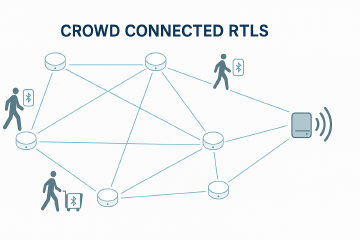
RTLS locates small wireless tags. Tags are clipped to assets (infusion pumps, wheelchairs, beds, monitors), worn on staff badges, or attached to patient wristbands. Beacons pick up signals from these tags and report their position continuously, so the platform always knows where each tag is. Hospitals use RTLS for asset utilisation, staff safety, patient flow through the ED, hand-hygiene compliance, and capacity reporting.
Modern hospital deployments often use both. The infrastructure - battery-powered Bluetooth beacons fixed to ceilings and walls - serves smartphones and tags at the same time, so the same investment unlocks wayfinding and tracking together. This is the practical reason hospitals end up procuring them as a single project, even though the two are conceptually distinct.
Why hospitals are different from generic location technology
Hospitals are not warehouses, offices, or retail floors. The constraints are different and so the technology choices are too.
Continuous clinical operations. Wards do not shut down for installation. Anything that needs contractor access to ceilings, power, or network cabling immediately runs into infection control, scheduling, and downtime constraints. The faster a system can be installed without disrupting clinical areas, the more viable it becomes.
Infection control. Devices and any installation work need to meet IPC standards. Battery-powered beacons that fix to walls with self-adhesive avoid the dust, drilling, and contractor presence that come with wired sensors.
Building heterogeneity. Most hospitals are not a single building - they are estates with PFI blocks, listed buildings, modular wards, decant units, and converted spaces. Systems that depend on consistent Wi-Fi coverage, identical room layouts, or a clean radio environment struggle here. Self-calibrating systems that adapt to each building automatically are essential.
Privacy and consent. Patients and staff are not a captive analytics audience. Cameras, facial recognition, and Wi-Fi MAC tracking all raise legitimate questions about consent and data minimisation. Indoor positioning that uses opt-in app-based location, and RTLS that uses anonymous tag IDs, start from a much better privacy position.
Regulatory environment. Procurement runs through formal MEAT (most economically advantageous tender) criteria, with weight given to clinical safety, information governance, integration with existing systems (PAS, EPR, any RTLS already in place), and ongoing support arrangements. Lifecycle cost matters more than headline price.
Asset value at risk. The cost of a misplaced infusion pump or wheelchair is not just the replacement - it is the search time, the downstream impact on patient throughput, the over-ordering of equipment to compensate for losses, and the cost of unplanned maintenance. Most hospitals significantly over-buy mobile equipment because they cannot find what they already own.
These constraints rule some technologies out before the comparison even starts. They also explain why hospital location technology projects lag the rest of the indoor positioning and RTLS market - the bar is higher.
What hospitals use indoor positioning and RTLS for
The use cases cluster into six areas. Most hospitals start with one and expand.
1. Wayfinding for patients and visitors (indoor positioning)
Smartphone-based indoor positioning gives patients and visitors a blue-dot location and turn-by-turn directions inside the hospital app. Visitors no longer have to follow ambiguous signage from the entrance, through corridors, lift lobbies, and bridges to find an appointment. The wayfinding works on the visitor’s own phone, with the hospital app and Bluetooth beacons doing the positioning.
Typical impact: fewer missed and late appointments, less pressure on reception staff for directions, and a measurable improvement in patient experience scores. Wayfinding is often the first use case that visitors and patients notice directly - which makes it useful for adoption of any wider hospital app.
2. Mobile asset tracking (RTLS)
The most established healthcare RTLS use case. Tagged equipment - infusion pumps, wheelchairs, beds, telemetry monitors, mobile imaging - is located in real time on a floor plan. Staff search the platform or a mobile app, see the nearest available item, and walk straight to it.
Typical impact: less time spent searching (often 30 minutes or more per nurse per shift), faster patient throughput, reduced over-ordering, lower theft and loss, and a defensible asset register for capital planning.
3. Patient flow (RTLS)
Tagged patients (most commonly in the emergency department, outpatients, or day surgery) are located through their pathway. The system can flag long waits, trigger handover prompts, or feed real-time capacity dashboards. ED-specific deployments often integrate with the trust’s patient administration system to combine location with clinical status.
4. Staff location and safety (RTLS)
Staff carry small tags - often combined with their existing badge - and can trigger an alert if they need help. Security or response teams see the alert location in real time on a floor plan and reach the staff member directly. Used widely in mental health wards, lone-working areas, and EDs.
5. Hand-hygiene compliance (RTLS)
Beacon-based hand-hygiene compliance monitoring measures the rate at which staff sanitise on entering and leaving patient areas. Used for IPC reporting and to identify wards or shifts that need additional training - it is a data source, not a punitive tool.
6. Capacity and space utilisation (location analytics)
Occupancy data across treatment rooms, theatres, ED bays, and wards shows real utilisation versus the timetable. Estates and operations teams use this for capacity planning, capital cases, and to identify under-used spaces that can be repurposed before new build is justified. This is closer to location analytics than to either smartphone wayfinding or tagged tracking - and a Bluetooth mesh platform can provide it from the same infrastructure used for wayfinding and RTLS. See healthcare location intelligence for the full operational view.
Most hospitals start with one use case (usually asset tracking, sometimes wayfinding or ED patient flow) and expand once the infrastructure is in place. The infrastructure cost is the same whether you track 100 assets or 1,000, and the same beacons that locate smartphones for wayfinding also pick up signals from RTLS tags.
Technology choices for hospitals
Four wireless technologies dominate hospital location technology in 2026. Each makes different trade-offs.
| Technology | Indoor positioning (smartphones) | RTLS (tags) | Accuracy | Cabling | Deployment time |
|---|---|---|---|---|---|
| Bluetooth mesh | Yes - iOS and Android | Yes - any BLE tag | 2-3 m | None (battery beacons) | Hours |
| UWB | No (no smartphone support) | Yes - proprietary tags | <30 cm | Power + ethernet per anchor | Weeks |
| Wired RFID | No | Doorway only | Per reader | Power + network per reader | Weeks to months |
| Wi-Fi positioning | Limited (Android-mainly) | Yes (Wi-Fi tags) | 5-8 m | None (uses existing Wi-Fi) | Days to weeks |
Bluetooth mesh (BLE)
Battery-powered beacons form a self-organising mesh network. Each beacon detects both smartphones (for indoor positioning) and nearby BLE tags (for RTLS), and relays position through the mesh to a single gateway per building. A typical 25,000 m² hospital wing needs one gateway and a few hundred beacons.
Why it works for hospitals:
- Single infrastructure supports indoor positioning and RTLS - same beacons, same gateway, same platform
- Beacons fix to walls with self-adhesive in hours - no contractor access, no cabling, no infection-control implications
- A single ethernet point per gateway is all the IT integration needed
- Works on iOS and Android for wayfinding, and with any standard BLE tag for RTLS
- Self-calibrating - adapts to each building, no fingerprinting walks required
- Total cost typically 65 to 90 percent less than wired alternatives
Where it is less suited:
- Not designed for sub-metre precision (if a workflow genuinely requires that, UWB is the option)
- Tags need replacement every few years as batteries deplete - though this is also true of wired RFID tags and is a smaller line item than the infrastructure savings
This is the modern healthcare default for both indoor positioning and RTLS, and where Crowd Connected operates.
Ultra-wideband (UWB)
UWB uses wired anchors and proprietary tags to achieve sub-30 cm accuracy through time-of-flight measurement. Strong in manufacturing and logistics where centimetre precision matters.
Why it’s less common in hospitals:
- No smartphone support - cannot be used for visitor wayfinding
- Anchors need power and ethernet at each installation point - significant capital and disruption
- Coverage per anchor is small (~500 m²) so anchor counts are high
- Proprietary tags - no second-source competition, higher per-tag cost
- Deployment takes weeks with specialist install
- The accuracy advantage is rarely operationally useful in healthcare - knowing an infusion pump is in “Bay 4 of Ward 12” is what matters, not which corner of the bay it sits in
UWB is the right answer in a small minority of hospital workflows - typically OR or pharmacy automation - but it is the wrong default.
Wired RFID
Older RFID readers wired into doorways or rooms detect tagged assets as they pass within centimetres of the reader. The technology that came before modern RTLS.
Why it’s mostly being replaced:
- Tells you when an asset passed a reader, not where it is now - “last seen” data, not real-time location
- Each reader needs power and network - high cabling cost at scale
- Tags work only when in close range of a reader - misses anything sitting in a corridor or store room between readers
- High infrastructure cost (typically 90 percent more than BLE mesh)
- No support for smartphone-based indoor positioning - a wayfinding project would need a parallel investment
- Limited to single-purpose asset tracking - no path to staff location, patient flow, or capacity analytics on the same infrastructure
Existing wired RFID deployments may be worth maintaining if recently installed, but new installations almost always favour BLE mesh.
Wi-Fi positioning
Repurposes existing Wi-Fi access points to estimate smartphone or tag position from signal strength. Sounds appealing because there is no additional hardware - but the practical accuracy is too low for most hospital use cases.
Why it falls short:
- Accuracy typically 5 to 8 metres - often not enough to distinguish between adjacent rooms or guide a visitor reliably
- Smartphone capture rates have degraded since MAC randomisation became standard, which particularly hurts wayfinding
- iOS support is limited due to Apple’s restrictions on Wi-Fi scanning, so Android visitors get a working experience and iOS visitors do not
- Coverage is limited to areas where APs reach reliably - gaps in stairwells, basements, plant rooms, outdoor areas
- Often requires a specific AP brand (Cisco, Aruba) with licensing costs that erode the “free infrastructure” argument
For zone-level estate analytics across a campus, Wi-Fi can work as a supplementary signal. For visitor wayfinding or mission-critical asset tracking, it is generally too imprecise.
For a fuller cross-industry technology breakdown, see our RTLS hardware comparison and indoor positioning technology comparison for 2026.
Vendor landscape: hospital location technology in 2026
Most general-purpose indoor positioning and RTLS vendors will sell into healthcare. A smaller group has meaningful hospital deployments. The shortlist usually narrows to five.
Crowd Connected
Technology: Battery-powered Bluetooth mesh with self-calibrating algorithm. Same beacons support smartphone indoor positioning (wayfinding) and tag-based RTLS (asset, staff, patient) on a single platform.
Strengths in hospitals: Hours-to-deploy beacons that need no cabling and no contractor access to clinical areas. Single gateway per building means minimal IT integration. Composable platform - same beacons support wayfinding, asset tracking, staff location, patient flow, and capacity analytics without additional hardware. Active deployments in hospitals and universities.
Best for: Hospitals that want hospital-wide coverage for both indoor positioning and RTLS from a single platform, fast deployment, and the lowest total cost of ownership.
Pricing: Significantly cheaper than wired alternatives. Pricing model is per-building rather than per-reader or per-tag.
Stanley Healthcare (AeroScout)
Technology: Wi-Fi RTLS (originally) plus BLE additions. Long-established healthcare RTLS vendor.
Strengths: Deep healthcare experience, integrations with hospital systems, strong US healthcare presence, comprehensive asset tracking software.
Less suited where: Wi-Fi RTLS accuracy limitations apply, and the infrastructure requirements (often a Cisco MSE alongside) make total cost high. Limited support for smartphone-based wayfinding. Newer BLE products narrow the gap but the legacy is Wi-Fi-first.
Sonitor
Technology: Ultrasonic positioning for RTLS - room-level accuracy by detecting which room a tag is in.
Strengths: Reliable room-level RTLS location, well-suited to workflows that genuinely need room-confirmed presence (some hand-hygiene compliance models). Healthcare-focused.
Less suited where: Coverage requires a sensor in every room, infrastructure cost is high, and the system does not provide spatial detail beyond room ID. No smartphone-based indoor positioning - a separate solution is needed for wayfinding.
Situm
Technology: Wi-Fi and BLE fingerprinting with sensor fusion. Smartphone-based indoor positioning, supplemented by BLE for some RTLS use cases.
Strengths: Active in healthcare and airport verticals. Cloud platform with analytics dashboards. Multi-technology approach provides some redundancy.
Less suited where: Fingerprinting-based - requires calibration walks during deployment and recalibration when the environment changes. Recalibration is particularly painful in hospitals where building layouts change often. See Crowd Connected vs Situm.
IndoorAtlas
Technology: Magnetic field fingerprinting, sometimes combined with BLE. Smartphone-based indoor positioning.
Strengths: Interesting technology that needs less infrastructure in some scenarios. Works on iOS and Android.
Less suited where: Magnetic signatures shift over time and between buildings, requiring re-fingerprinting. Not designed for tag-based RTLS, so asset tracking and staff safety would need a separate solution. See Crowd Connected vs IndoorAtlas.
For a wider list including non-healthcare vendors, see Best indoor positioning systems for 2026.
Procurement considerations
A hospital procurement runs differently from a corporate one. The questions to put on a tender, or to use as a structured comparison, are:
1. Does the platform cover both indoor positioning and RTLS - or just one? A platform that handles smartphone wayfinding and tag-based RTLS from the same beacon infrastructure avoids running two parallel projects. If you start with one use case, you want the path to the other already built in.
2. What is the total deployment cost - not just the hardware? Include cabling, contractor access, project management, software, tags, integration, and ongoing licence fees. Wired systems often have hardware costs that look competitive until installation is added.
3. How long does deployment take, and what is the disruption to clinical areas? Hours-to-days with battery-powered beacons. Weeks-to-months for wired systems. The faster systems often save more than their hardware price in avoided clinical downtime.
4. How does the system handle building changes? Hospitals reconfigure constantly. A self-calibrating system handles this. A system that requires fingerprinting on every change does not.
5. What is the IT integration footprint? A single gateway per building with one ethernet connection is the lightest option. Wired RFID and Cisco-dependent systems need significant network integration.
6. Is the platform composable? Can the same infrastructure support wayfinding, asset tracking, staff location, patient flow, and analytics? Or does each use case require separate hardware? Composable platforms accumulate value over time.
7. What is the tag ecosystem? Proprietary tags lock you into one vendor’s pricing. Open BLE tag compatibility gives second-source competition and a wide range of form factors.
8. How is data handled - GDPR, information governance, integration with hospital systems? Tag IDs (anonymous) and opt-in app location avoid most issues. Camera-based and Wi-Fi-MAC systems need extensive DPIA and information governance review.
9. What is the renewal economics? Tags need replacement every few years. Software licences renew annually. Get clear numbers on the year-three and year-five total cost, not just year one.
10. Reference deployments at comparable hospitals? Healthcare location technology is operationally specific. Ask for live deployments at hospitals of similar size and similar use case mix - not just generic indoor positioning or RTLS deployments in other sectors.
How to choose
For most hospitals in 2026, the decision is straightforward:
- If you want hospital-wide indoor positioning for wayfinding, RTLS for asset and staff tracking, or both - and you want to deploy quickly, with minimal disruption to clinical operations, at a defensible total cost - Bluetooth mesh on a composable platform is the right answer.
- If you have a specific workflow that genuinely needs centimetre accuracy (a small subset of OR or pharmacy automation projects), UWB has a role for that workflow - but only where its infrastructure cost is justified, and recognising it cannot do smartphone wayfinding.
- If you have existing wired RFID and it is performing, maintain it - but new investment should usually favour BLE mesh, which provides everything wired RFID does plus real-time location, smartphone wayfinding, lower cost, and a path to additional use cases.
- Wi-Fi-based positioning is rarely the right choice for safety-critical or visitor-facing wayfinding use cases. It can supplement a primary system for low-precision zone analytics.
The wider trade-off is between deployment speed and precision. For hospitals the operational case usually rewards speed and coverage over precision. Two-to-three-metre accuracy across an entire estate, deployed in weeks, beats sub-30 cm accuracy in a single ward, deployed over months - especially when the same infrastructure also gives you visitor wayfinding for free.
Next steps
If you are scoping a location technology project for a hospital, the practical sequence is:
- Define the priority use case (wayfinding, asset tracking, or ED patient flow are the most common starting points)
- Identify the buildings or wards in scope
- Run a structured comparison against the procurement considerations above
- Look at reference deployments at comparable hospitals
- Pilot in a single ward or building before committing to estate-wide rollout
Crowd Connected provides indoor positioning and RTLS for hospitals as a single, composable platform - wayfinding, asset tracking, patient flow, staff safety, and capacity analytics from the same battery-powered Bluetooth mesh infrastructure. See healthcare location intelligence for the use-case detail or RTLS asset tracking for the technology and pricing.
Comparing vendors? See our wider indoor positioning systems comparison for 2026 or the technology-level comparison of BLE, UWB, Wi-Fi, and hybrid systems.