Best event attendee tracking solutions compared (2026)

Best event attendee tracking solutions compared (2026)
Event attendee tracking captures who attends which sessions at a conference, exhibition, or event - including when they arrived, how long they stayed, and where they went next. The right solution gives organisers complete session-level data without adding friction for delegates.
But the options vary enormously in cost, accuracy, and effort. This guide compares the leading approaches for 2026, with honest assessments of where each works best and where it falls short.
Quick comparison
| Solution | Accuracy | Setup effort | Delegate friction | Data granularity | Best for |
|---|---|---|---|---|---|
| Bluetooth wearable tracking | High (room-level + dwell time) | Hours | None (passive) | Session attendance, dwell time, movement paths | Multi-track conferences, exhibitions, CPD |
| RFID (long-range passive) | Moderate (~70% read rate in crowds) | Days | Low (walk through arch) | Entry only (direction hard to determine) | Controlled access, credentialling |
| NFC tap-in | Exact (tap = present) | Hours | Moderate (must tap) | Entry/exit only | Access control, small events |
| QR code scanning | Exact (scan = present) | Hours | Moderate (staff scan badge) | Entry only | Budget events, simple check-in |
| Wi-Fi tracking | Low (zone-level) | Days | None (passive) | Approximate zone presence | Rough occupancy estimates |
| Manual counting | Low (head count) | Minutes | None | Aggregate count only | Small rooms, backup method |
| App-based tracking | Medium (depends on adoption) | Weeks | High (requires download) | Varies | Events with existing high-adoption app |
| Hybrid approaches | Varies | Varies | Varies | Varies | Complex multi-venue events |
1. Bluetooth wearable tracking
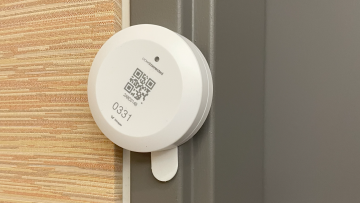
How it works: Each delegate wears a small Bluetooth tag, typically clipped to their lanyard or badge. Battery-powered mesh beacons installed around the venue detect signals from these tags and relay position data to a cloud platform in real time. No scanning, no tapping, no action required from delegates.
Pros:
- Completely passive - zero friction for delegates
- Captures continuous presence data (dwell time, not just check-in)
- Tracks movement between sessions, networking areas, and exhibition halls
- Deploys in hours with battery-powered, self-adhesive beacons
- Works across entire venues including corridors, foyers, and outdoor areas
- Data available in real time during the event
- Tags are reusable across events, reducing per-event cost
- Infrastructure cost is low - battery-powered beacons need no cabling
Cons:
- Requires distributing tags at registration (adds a step to check-in)
- Tags need to be collected at event end to keep per-badge costs down (though this is increasingly automated)
- Accuracy is room-level (a few metres), not seat-level
- Cannot provide access control (no gate or barrier function)
Best for: Multi-track conferences, exhibitions, medical conferences with CPD requirements, and corporate events where you need complete session-level data across an entire venue without adding friction or staffing.
Example provider: Crowd Connected delivers two to three events per week across 100+ venues globally. A typical 500-delegate conference requires 15 kg of hardware that fits in carry-on luggage, needs a single power point and network connection on site, and is installed in around four hours. Trusted by Informa, Docusign, Oxford Global, and Channel Futures.
2. RFID (long-range passive)
How it works: Delegates carry badges embedded with a passive UHF RFID chip. Long-range reader arches or antennas installed at session doorways detect the chip as delegates walk through - no tapping, no scanning, no stopping. Each detection creates a timestamped record tied to the individual.
Pros:
- No deliberate action required from delegates - they just walk through the doorway
- Well-established technology with wide vendor availability
- No battery or charging required for tags
- Low per-badge cost (RFID chip is built into the printed badge)
- Can double as access control when combined with barriers
Cons:
- Read accuracy drops significantly in crowds - when multiple people walk through an arch simultaneously, accuracy can fall to around 70%
- Requires wired RFID reader arches and antennas at every session entrance - significant hardware, cabling, and installation
- Dwell time is unreliable because the arch can’t distinguish entry from exit - it just detects that a badge passed through
- Expensive per location: readers, cabling, power, and specialist installation at every doorway
- RFID chips are built into disposable badges and can’t be reused across events
- Sensitive to environmental interference (metal doors, dense crowds, tag orientation)
- Significant lead time for planning and installing doorway hardware
- For access control, delegates must pass through the arch one at a time while staff wait for confirmation - creating bottlenecks at busy sessions
Best for: Events where controlled access is the primary goal and the budget for doorway reader installations is available. Less suitable for session-level attendance analytics due to accuracy and dwell time limitations.
3. NFC tap-in
How it works: Each delegate badge contains an NFC chip. A static NFC reader is mounted at the session entrance. Delegates tap their badge on the reader as they enter - a deliberate, close-range action (within a few centimetres). Each tap creates a timestamped entry record.
Pros:
- Precise identification - each tap is an unambiguous attendance record
- Clear entry vs exit (tap in, tap out) makes dwell time reliable
- Low hardware cost per reader - static readers are inexpensive
- Probably the best option for access control - deliberate action at a fixed point
- Simple, familiar interaction (similar to contactless payment)
Cons:
- Requires a deliberate tap - not passive
- Creates queues at busy sessions, particularly multi-track events with back-to-back sessions
- Lower compliance rates than passive systems (delegates forget or choose not to tap)
- Only captures the tap moment, not in-session movement
- Requires staffing or monitoring to ensure delegates actually tap
- NFC chips are built into disposable badges and can’t be reused
Best for: Events where access control is important, or smaller single-track events where the tap can be integrated into a natural entry flow. The strongest option when you need a deliberate, auditable record of attendance at a specific point.
4. QR code scanning
How it works: Each delegate badge is printed with a unique QR code. Staff scan the badge with a phone or handheld reader as delegates enter the session. Each scan creates a timestamped attendance record tied to the individual.
Pros:
- Very low hardware cost - staff use their own phones or inexpensive handheld readers
- Easy to set up - QR codes are printed directly onto badges during registration
- No additional hardware on delegates beyond their standard badge
- Can be combined with other badge features (schedule, networking details)
Cons:
- Requires staff at every session entrance to scan badges
- Only captures entry, not dwell time
- Creates queues, particularly at busy sessions with back-to-back scheduling
- Compliance depends on staffing - delegates who aren’t scanned are missed
- Scanning speed limits throughput at high-traffic doorways
- Labour costs add up quickly across multi-track events
Best for: Budget events with a small number of sessions, or as a supplementary check-in method alongside passive tracking. Works well when you need a simple, low-cost attendance record and have staff available at doors.
5. Wi-Fi tracking
How it works: Venue Wi-Fi access points detect the MAC addresses or probe requests of delegates’ smartphones. By triangulating signals across multiple APs, the system estimates which zone each device is in.
Pros:
- Uses existing venue infrastructure (no additional hardware)
- Completely passive - no delegate action required
- Can cover very large areas
Cons:
- Accuracy is zone-level at best (typically 10-15 metres) - insufficient for room-level session tracking
- MAC address randomisation (now standard on iOS and Android) severely undermines identification
- Cannot associate signals with named individuals without separate opt-in
- Inconsistent coverage - depends on AP density and placement
- Privacy regulations make passive device tracking increasingly problematic
Best for: Rough occupancy estimates across large areas (e.g., how many people are in a hall), not for session-level attendance tracking. Increasingly unreliable as a primary method due to MAC randomisation.
6. Manual counting
How it works: Staff or volunteers count delegates entering sessions, either with clickers or visual estimates.
Pros:
- No technology required
- Immediate, no setup
- Works anywhere
Cons:
- Labour-intensive - needs staff at every session
- Captures aggregate numbers only, not individual attendance
- Highly inaccurate for sessions with free-flowing entry/exit
- No dwell time, no individual identification, no digital export
- Doesn’t scale beyond a handful of rooms
Best for: Small breakout sessions as a backup method, or events with no budget for technology. Not suitable as a primary tracking method for events of any scale.
7. App-based tracking
How it works: The event’s mobile app includes location tracking (using Bluetooth beacons, Wi-Fi, or GPS). If delegates download and use the app, their session attendance is tracked automatically.
Pros:
- Can provide rich data including dwell time and movement patterns
- Integrates with event content, schedules, and networking features
- No separate wearable needed if delegates already use the app
Cons:
- Depends entirely on app adoption rate - typically 30-60% at best
- Data is only as complete as adoption allows
- Requires Bluetooth/location permissions, which many users decline
- Battery drain concerns reduce willingness to keep location active
- Weeks of development/integration lead time
Best for: Events that already have high app adoption (70%+) and want to add attendance tracking as an incremental feature. Not recommended as the sole tracking method unless adoption is very high.
8. Hybrid approaches
How it works: Combining two or more methods - for example, Bluetooth wearable tracking for session attendance data alongside QR codes for session feedback, or long-range RFID for credentialling at the main entrance combined with Bluetooth tracking inside sessions.
Pros:
- Addresses multiple objectives with appropriate tools
- Can provide both credentialling and analytics
Cons:
- More complex to set up and manage
- Data from different systems may not integrate easily
- Higher total cost
Best for: Large multi-venue events with different tracking requirements in different areas (e.g., RFID-secured VIP areas plus Bluetooth tracking across the general conference).
How to choose the right solution
The right choice depends on what you’re actually trying to achieve:
If you need complete session-level data for sponsor reporting and content optimisation, Bluetooth wearable tracking is the clear winner. It captures every session, every delegate, with dwell time - without adding friction or staffing. This includes medical conferences with CPD requirements, where passive tracking provides a complete, auditable record of who attended each session and for how long.
If you need access control (restricting who can enter specific sessions or areas), NFC tap-in is probably the strongest option. The deliberate tap at a fixed reader gives you an unambiguous record and a natural control point. RFID arches can also provide access control, but delegates need to pass through one at a time while staff wait for confirmation, which creates bottlenecks.
If you’re on a tight budget with a small number of sessions, QR badge scanning gives you a simple check-in record with minimal hardware cost. Just be realistic about what you’ll get - entry data only, and you’ll need staff at every door.
If you want to avoid distributing hardware entirely, app-based tracking works if your app adoption is genuinely high. For most events, it isn’t.
For the vast majority of conferences and exhibitions in 2026, passive Bluetooth wearable tracking offers the best combination of data quality, delegate experience, and ease of deployment. It’s the approach that’s growing fastest for good reason.
Want to see how Bluetooth attendee tracking works in practice? Read how Informa Connect deployed session-level tracking across their global conference programme, or explore the attendee tracking solution in detail.